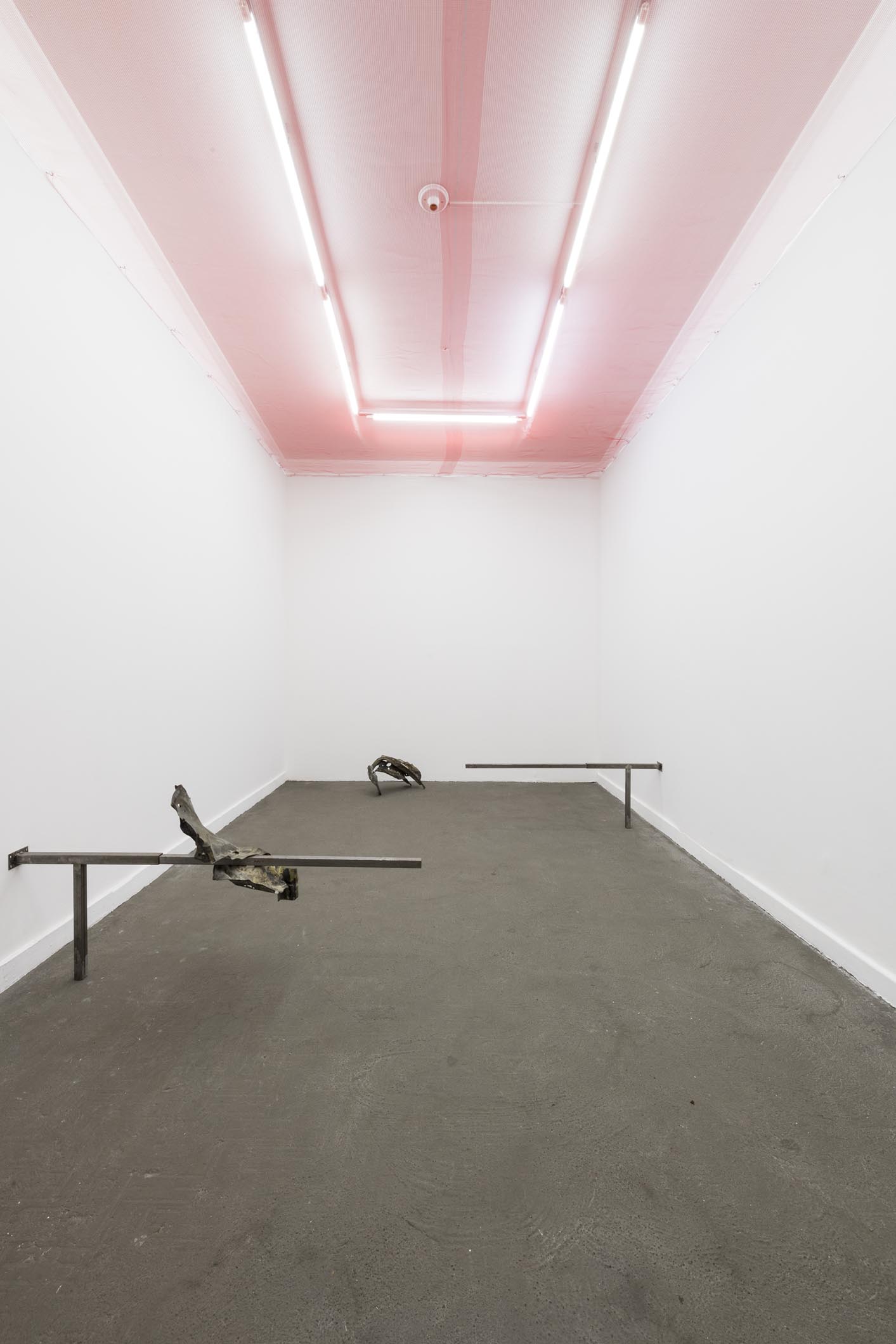
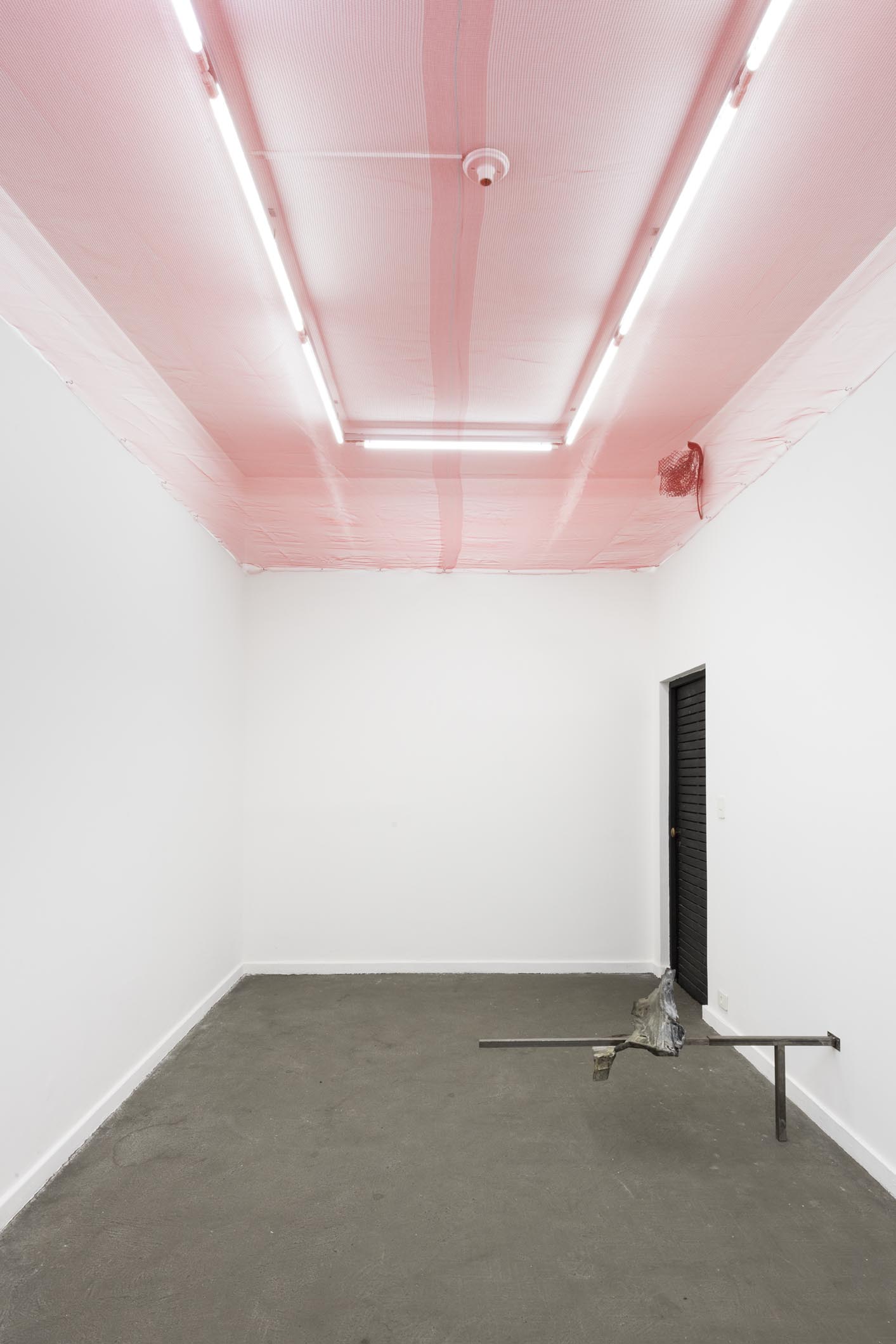
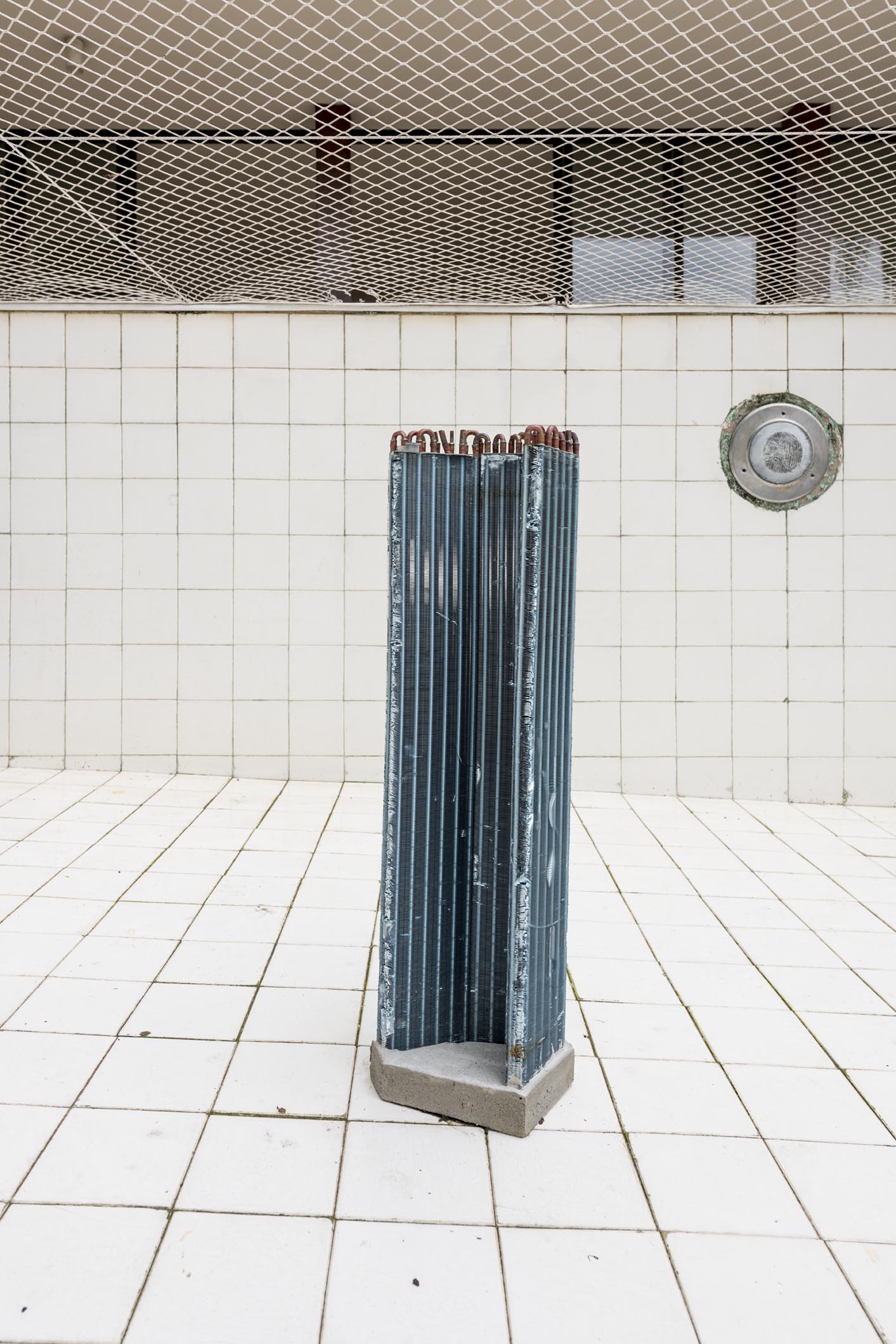
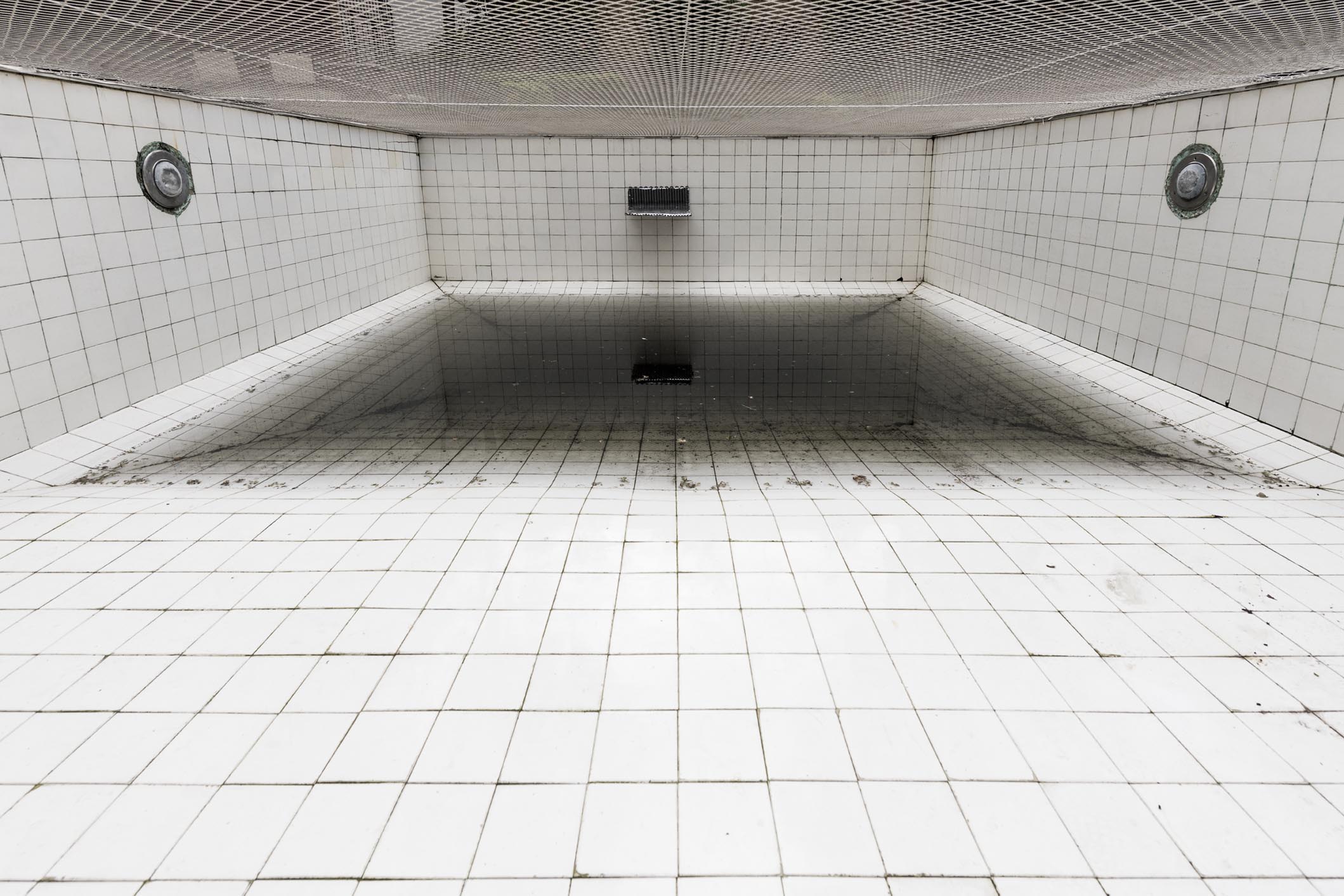
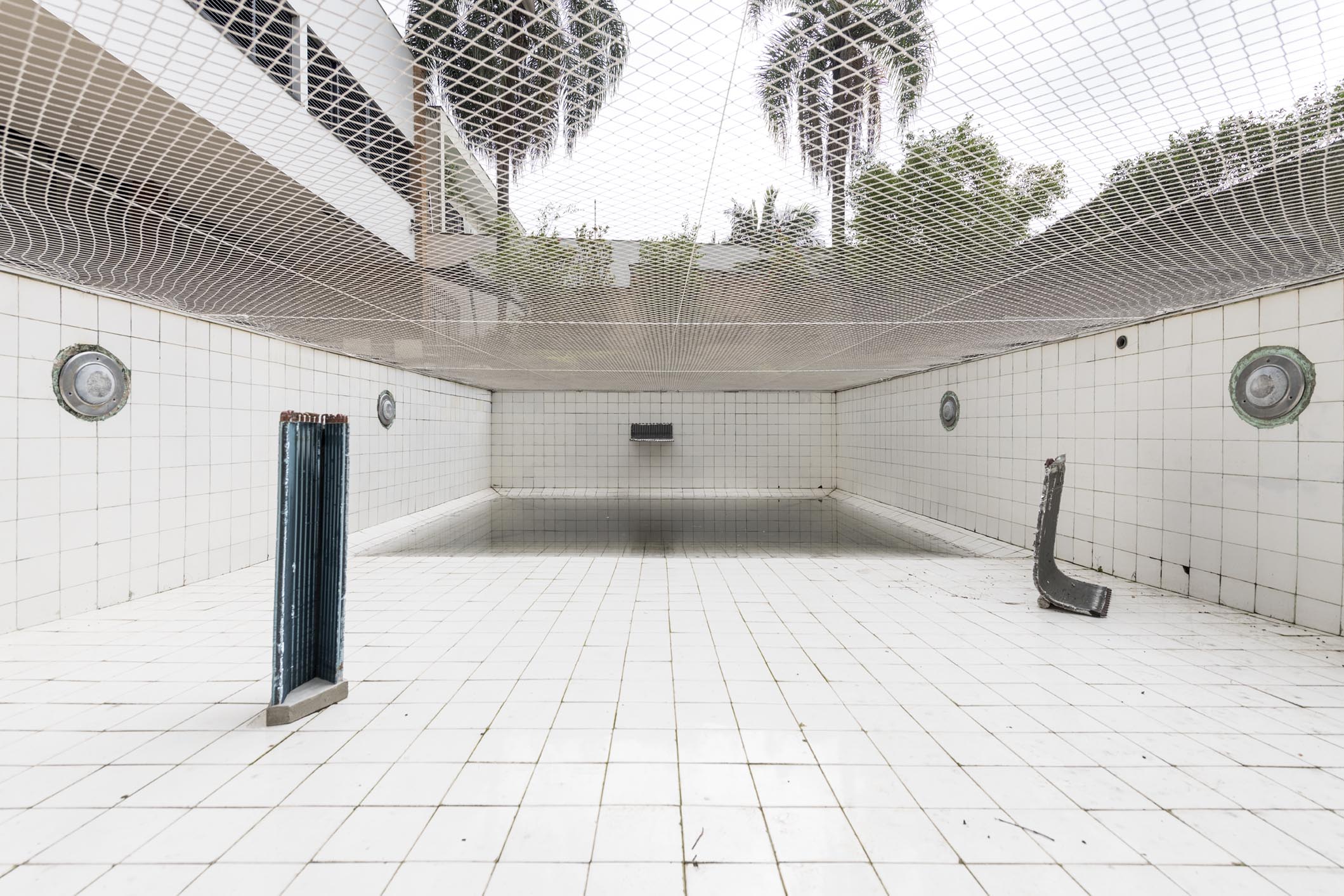
The first project selected from the auroras open call for proposals is the installation Pane Seca, by Daniel Frota de Abreu, a work specifically designed for the Project Room. The work consists of a group of objects and interference in the architecture of the space. The sculptures are formed from industrial, synthetic and organic fragments, modified and arranged in a kind of desolate landscape of transitory materiality. Actions of time, accumulation, disposal and decomposition are processes that served as starting points for the fusion of technological and natural qualities in hybrid objects. These pieces are under a red shade screen, used in the construction of greenhouses and protected cultivation techniques, thus creating controlled environments for metabolic developments. In addition to the installation in the Project Room, Daniel Frota also occupies the auroras pool, recreating the same greenhouse environment into the earth.
Pane Seca
Daniel Frota de Abreu (1988, Rio de Janeiro) holds a degree in graphic design from PUC-RJ, a master’s degree from the Werkplaats Typografie ArtEZ Institute of the Arts, Arnhem and a postgraduate degree from the École Nationale Supérieure des Beaux-Arts de Lyon. He produces videos and sculptures, working directly in the exhibition space in specific installations. He recently participated in exhibitions at the Iberê Camargo Foundation, Porto Alegre (2018); CalArts, Valencia, USA (2018); Paço das Artes / MIS-SP, São Paulo (2017); Fondazione Sandretto Re Rebaudengo, Turin (2016); Musee des Confluences, Lyon (2016); Videobrasil Festival, São Paulo (2015). In 2015 he was awarded the 3 Package Deal residency award by Amsterdams Fonds Voor de Kunst, Amsterdam. He currently participates in the research program Art by Translation (2018-19) by ENSA Paris-Cergy / ENSBA TALM Angers.
Who inhabits the auroras house?
In a writing in which he tries to define his interest in artistic activity, Daniel characterizes his work as the beginning of impasses provoked in thinking about objects without humans. A task of thought that, if in the art of rhetoric, would denounce an old sophist still imagining an object that acquires meaning without any imperative of reason, but that here, perhaps because he is actually a designer by training, the artist delays, at least a few moments, in having from the repetition of his thought the rejoicing with some infinity, in a time beyond man; and in this delay consists the projective work.
Here, the artist designs, for the house, two arrangements of objects to claim the furniture: one at the front, occupying the project room, the old garage, and another at the back, in the empty swimming pool. These are untitled objects, which are generally arranged low, on the floor or suspended next to it.
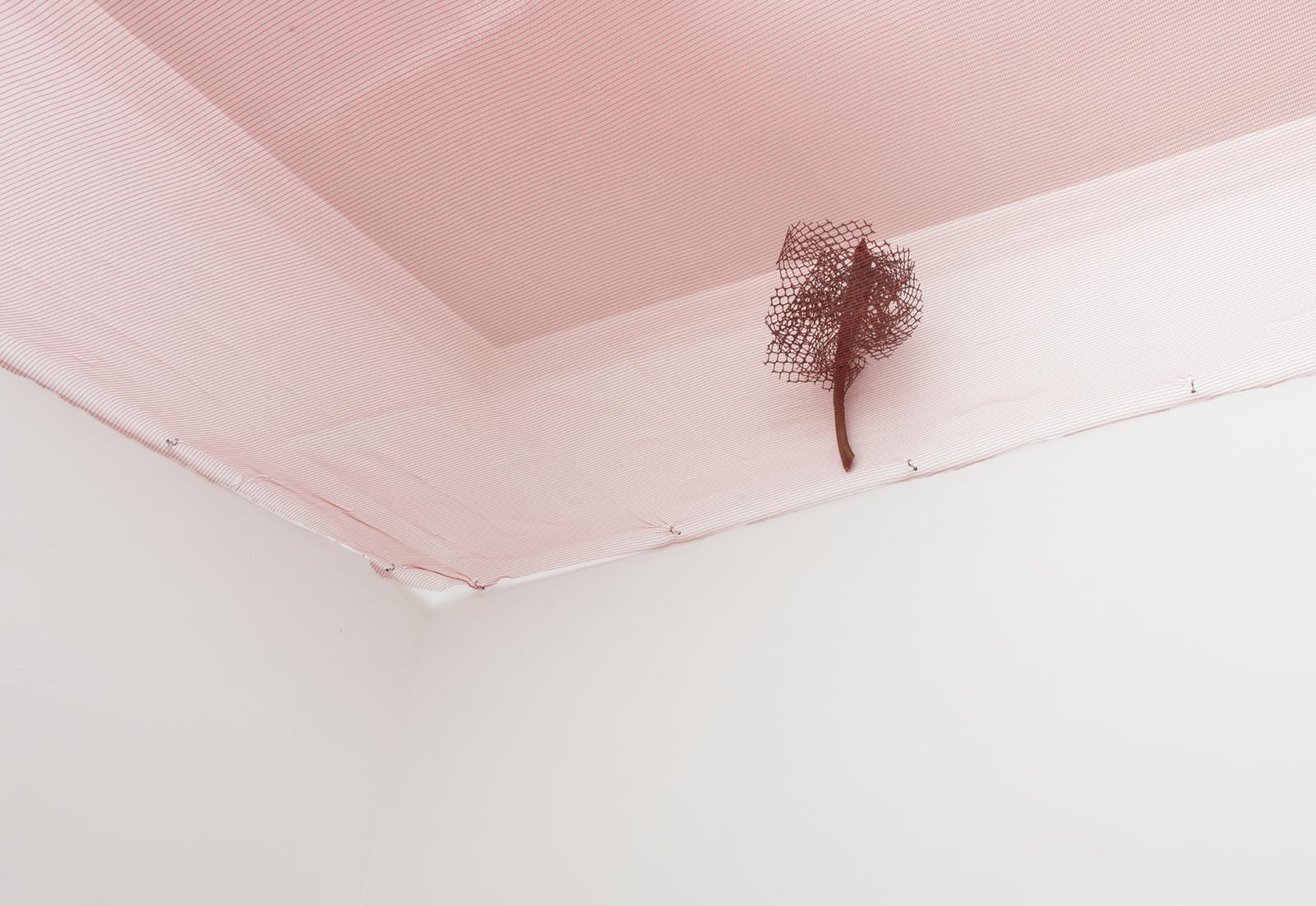
In the garage, a screen projects a sky, red, as if dyeing a flat atmosphere to the top of our heads, in order to level the sloping ceiling. And every inch of red fabric that runs past the top of our heads seems to correspond with a coordinate farther out on the horizon. A dry branch, wrapped in plastic and called a “cocoon” is fixed above the weave, over the door, in the privilege of omniscience, watching two automobile parts destroyed by the heat and two supports fixed on opposite walls, one in use of a function. and the other did not, dropping the piece of iron, which, we intuited, would be assigned to him, to the ground. This lowering of the pieces to the floor, which almost puts us back in an aerial view, lifting us to the places in the house and making us occupy a higher sense in space, reveals, at the risk of stumbling, objects full of animosity that, from art, learn to dismay the scale of their surroundings.
So when in the pool, which is covered by a white net, one can see, from the shore, these other objects, either bluish or reddish, weighing on the bottom; or even when, as if to verify the distortion or the correct color of submerged things, we descend and enter beyond the net, bent over to fit in the low environment scrutinized by tiles – then it is noticed in an instant that, mediated by the basin, these wrecks they don’t let the scale of the body settle in their relationship. The images that the two environments make up resemble models of desolate scenarios, lacking in scale, and thus of history that goes back to life, to the village, but for that very reason devoid of catastrophe. Even so, something grotesque enters the work in the very condition of existence of its objects, protagonists of an event whose implication tends to be negative – of things broken, disarticulated, spilled, burned; extracted from an accident, or perhaps an explosion.
There is, therefore, an event, first and prior to the arrangement, which mobilizes the work and which, abandoned as a procedure, remains as the reason for the forging of the arrangement. The rest of the procedures – which, for example, range from the caprice of leveling the ceiling to the cocoon, witness everything – reveal a taste for closed systems, and in the contained spaces, symbolically split, as operated by frames, they find a manifesto. It is not, then, for nothing how well the artist’s objects are behaved in the internal spaces, welcomed as if they were domestic. But, in order not to say it just contenting ourselves with noticing the good lesson about what is on the verge of becoming decorative, we return to the artist’s impasse, with the question of who, if not nobody, nor somebody, inhabits these disconcerting models? Who stumbles more than they walk, and therefore walks well without a guarantee of a positive relationship with space? For us, whatever the crooked creature, it is possible, although this grotesque will certainly haunt the house during the exhibition. If there is any viable success in employing the imagination for an object so autonomous to man’s senses, where else if not in the production of the grotesque is it to be measured?
Nicolas Mangolim