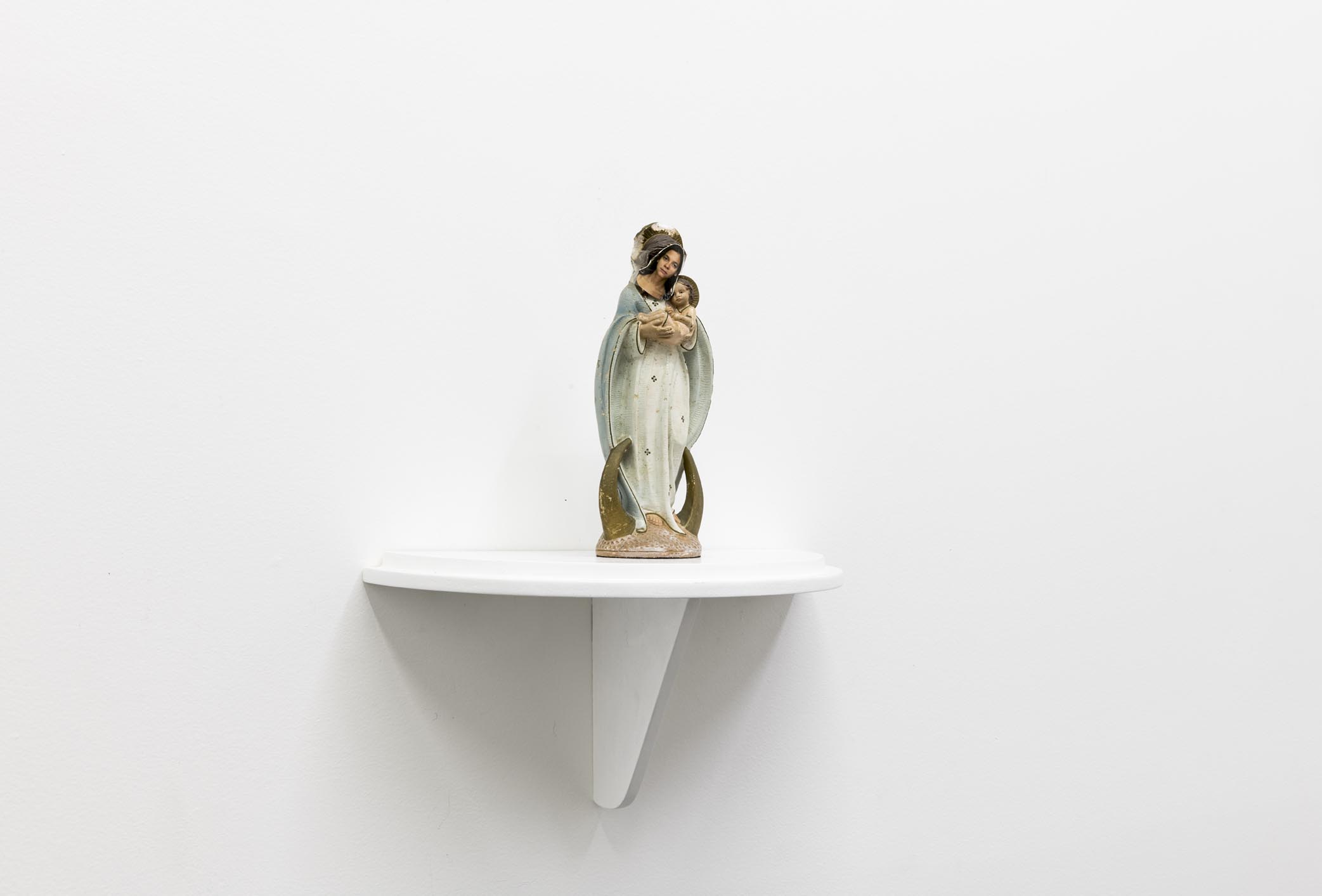
Santa Anitta, in joy and sadness
by Lisette Lagnado
Few artists are known by both their first and last names. When I arrived in Rio de Janeiro in 2014 to live in the superlative city of all evils and splendors, Anitta was already wearing her nickname of the good life, she was already a saint of the good time, good debauchery, good breeze and good trip. How much can a personality influence the judgment made about her creative work? In the present case, almost everything. There is no distance between subject and action. Anitta would be the genuine daughter of the generation from the south of Rio, who spent their youth strolling between Ipanema beach and the Parque Lage School of Visual Arts, were it not for a disconcerting irony in the way of seeing and expressing the world. As much or more voyeur than Alair Gomes (her spiritual father, so to speak), the human genre is the main subject, scrutinized in types without qualities, but full of the charm and smoothness of musical behaviors. Portraits (2015-2017) are visual chronicles that condense affective characters taken in domestic scenes, but pose for a story destined for the tragedy of oblivion. If she had been born in Proust’s time, Boa Vida would illustrate our time that flows in chatter on social media, likes and memes of a definitely vain mundanity. Humor, however, ends up being her acid salvation from despair, the sign that crosses each image with a piercing phrase, to signal a deeper level that manages to rise in motto and fight against ills such as racism and patriarchy. After all, for someone so skeptical, the anonymity that governs privacy in the digital age can only be a facade. With no option against a reputation as a cursed icon, Our Lady of Good Life also announces the uncertainty of the canon and the virtues of an Art yet to be deciphered…
there where the most proper is the strangest and most impersonal, the closest is the most remote and indomitable
by Ulisses Carrilho
Although it is explicitly present in the works “Nossa Senhora da Boa Vida” (2015) – a saint that is part of this installation -, in the series of photographs “Dê Gudi Laife” (2013) or in the surname chosen by the artist in her adult life, the modus vivendi good life appears in other of her works or projects. These often make use of the integrated practice of writing and drawing in notebooks, loose papers, lighters, plastic bags, magazine covers and other various advertising apparatus and mass consumption media, as well as city walls – Eu dei pra ele (2015). It is worth reading the drawings and absorbing the form of the texts – the artist draws speeches. Although Ora que melhora is a site-specific project, this work methodology is recurrent in the strategies chosen by her: Anitta Boa Vida takes advantage of the space to emphasize an invisible architectural feature – in Um Microfone na Torre (2013-2016), she dealt with if it is an acoustic dynamic, here it is a vocation of the room to be a small chapel, going back to the domestic use of the property – through a simple operation, guided more by a conceptual order than by materiality, sculptural character or discussion in the narrow field of art history. Anitta Boa Vida prefers to circulate in the field of visual culture, where images are presented as everyday aesthetic facts, impregnated with impulses, cause and effect of the force that moves the blood in our veins or makes us fall into a deep sleep, the unknown potency that, in our body, regulates and distributes so smoothly the lukewarmness and dissolves or contracts the fibers of our muscles. (AGAMBEN, Giorgio. Profanations)
by Caroline Valansi
Anitta, an artist in the south of Rio de Janeiro, after so much pixo and sex, our lady of Good Life is canonized. Patroness of artists and coquettish women. Amen and Amen, too Much!
by Maria Moreira
Anitta has a small body, natural from the cracks, an almost space, almost nothing is her place. Will Anitta shine? What sparkle fits the eye’s attention under the seaside sun? Ivo Ito used to say that on the beach you can’t hide anything, almost naked, he got restless. Killed himself with cooking gas. The decision came as a surprise — if time could bend to itself, in the burst of our desire, Ivo Ito would be in Anitta’s photos. Bareback, heart in the abyss. The eye of the crack, Anitta’s eye, writes. It removes the skin of the word that is leftover in the day’s mishaps. Words of order, a word in disorder, smeared with streets. Antonio Manuel got naked at MAM. I wanted home. Is the museum home? Anitta’s body-crack welcomes monuments-stamps in the shadow of her nudity. The measure of all things — human nakedness. The naked girl virgin mother of the boy. Desiring the impossible. The snake on the moon. Ask, at eye level.